

Few objects are as ubiquitous and yet as overlooked as the safety sign. Pinned to warehouse walls, mounted above emergency exits, and stencilled onto factory floors, these symbols form a silent visual grammar that governs daily life. Yet their reach extends well beyond the industrial world: scholars and writers have long recognised that the language of warning, boundary, and protection carries a surprisingly rich symbolic charge. Exploring this connection opens unexpected doors into broader cultural conversation.
Key points
- Safety signage functions as a universal visual language that instantly communicates warnings, though it also encodes societal assumptions about risk and authority.
- In literature and film, industrial warning symbols serve as narrative tools to establish corporate environments or delineate forbidden boundaries.
- The use of safety and hazard imagery in fiction adds a layer of documentary realism by grounding invented worlds in recognizable institutional contexts.
- Authors like Henry Seton Merriman utilized tropes of disease and physical boundaries as metaphorical hazard signs to define moral and ideological territories.
- The symbolic coding of safety and danger has historically been used to categorize populations and spaces, with these inherited biases still influencing modern perspectives on identity and illness.
- Both industrial signage and literary symbols rely on shared cultural conventions to shape human behavior and collective memory.
How Does Safety Signage Function as a Visual Language in Modern Culture?
The Semiotics of Warning Symbols: Reading Between the Lines
A warning triangle, a skull and crossbones, a figure fleeing through a door — these images communicate instantly, across language barriers, in a fraction of a second. That speed is the whole point of safety signage: it must be understood before the mind has time to deliberate. Yet semioticians have noted that what appears purely functional is also deeply cultural. The colours chosen, the shapes employed, and the postures of stylised human figures all encode assumptions about danger, authority, and the human body. In this sense, every sign is also a statement about how society imagines risk and responsibility. Reading workplace signage carefully reveals a shared visual vocabulary that shapes collective instincts in ways most people never consciously register.

From Factory Floors to Fiction: Safety Signs in Contemporary Narratives
Writers and filmmakers have frequently borrowed the iconography of industrial signage to shorthand particular atmospheres — the alienating corridor of a corporate dystopia, the charged threshold of a forbidden zone. The sign marking a boundary is a recurring device in fiction because it does in a sentence what prose sometimes needs a paragraph to achieve: it signals that crossing a line carries consequences. Scholars studying narrative studies have pointed out that such objects anchor stories in recognisable social spaces, lending a documentary texture to invented worlds. The biohazard symbol, the hard-hat requirement notice, the chemical hazard label — each one arrives in a scene carrying an entire institutional history on its back.
Where Do Industrial Signage and Symbolic Meaning Intersect in Literature?
Metaphorical boundaries: safety equipment as literary device
The intersection of safety culture and literary symbolism becomes particularly striking when one considers how protective equipment has been used metaphorically across different traditions. Scholars working on colonial narratives and medical literature have shown that boundaries — physical, moral, and epidemiological — were constantly being drawn and redrawn in the texts of the colonial era. Research into the literary treatment of tropical disease illustrates how writers like Henry Seton Merriman wove illness into their fiction as a marker of moral and physical boundaries, presenting disease as a kind of natural warning sign posted at the edges of empire. In these texts, symptoms of sleeping sickness or malaria function almost like hazard labels, alerting readers to danger zones defined not just by geography but by ideology.
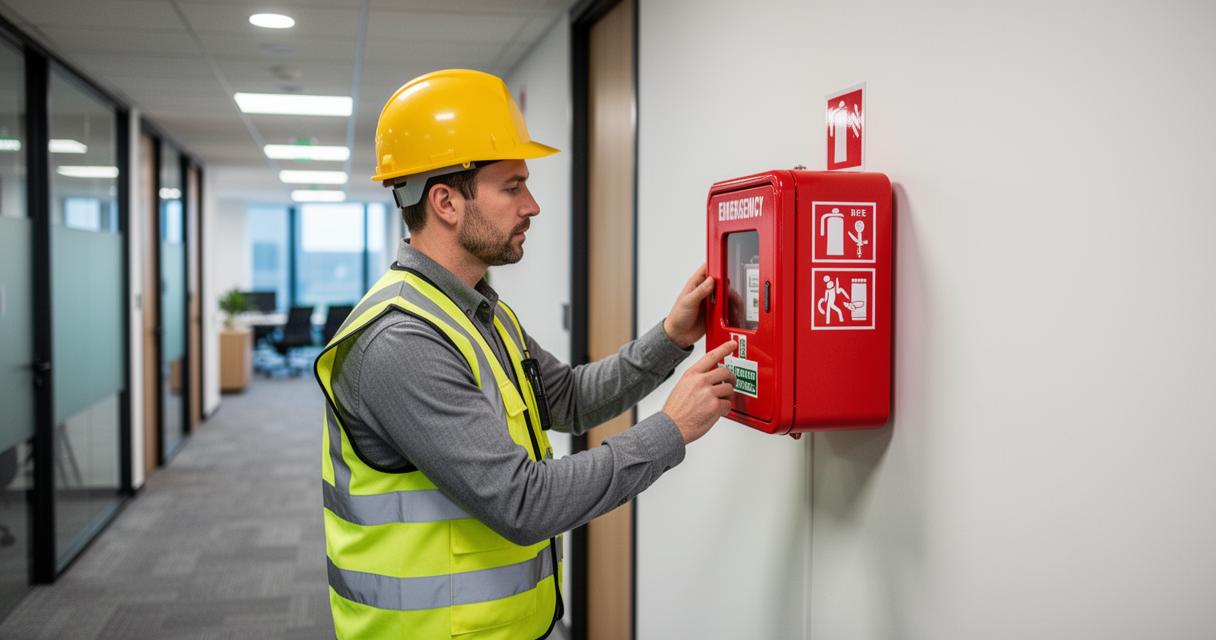
Cultural codes: how workplace signage shapes collective imagination
The societal impact of visual warning systems extends, perhaps surprisingly, into the realm of public perception and historical memory. Research into disease representation has demonstrated that the imagery surrounding illness — in medical literature, public health campaigns, and popular fiction — shapes understanding in ways that can persist for generations. Colonial-era imperial medicine produced its own system of symbolic coding, sorting populations, territories, and behaviours into categories of safe and dangerous with the blunt efficiency of a hazard sign. Contemporary scholarship on health and race continues to interrogate those inherited codes, asking how the visual and rhetorical languages of earlier eras still echo in present-day historical perspectives on illness and identity. Understanding that legacy is part of what it means to read any system of signs — industrial or literary — with genuine critical attention.
Taken together, the world of safety signage and the world of symbolic literature are less separate than they might first appear. Both rely on shared codes, both shape behaviour through the power of suggestion and convention, and both leave lasting impressions on the collective imagination. Approaching either field with curiosity, rather than taking it for granted, reveals the surprising depth concealed in the most familiar of objects.